FILE:01
THE ORIGINS
Tracing the bloodline from Anatolia to the Abstract,
FILE: 001 / PREAMBLE
ANCIENT ROOTS
Creation in Stone & Spirit
The impulse to create visionary works is not confined to painting or modern history. It is an ancient human endeavor to give form to the energetic and celestial forces that shape our world.
The ancient Egyptians, for example, were prolific creators who infused their works with celestial influences. Their focus was often on the energetic resonance of what they built, knowing that a structure aligned with divine principles would naturally possess a profound visual harmony. This is a foundational visionary concept: creation as a medium between the material and spiritual realms.
This tradition continued through groups like the Knights Templar, whose architectural marvels were expressions of a deeper spiritual code. Their fortress-like churches blended military function with sacred purpose, often incorporating sacred geometry and Gothic elements like pointed arches and ribbed vaults. By building structures that followed the earth's natural energetic ley lines and adhered to divine proportions, they transformed architecture into a spiritual experience, turning stone into a conduit for the visionary.
HILDEGARD OF BINGEN
(1098-1179)
A true medieval polymath, the German abbess Hildegard of Bingen was a mystic who experienced powerful visions of a transformative light from a young age. At 42, she received a divine message: "Write down what you see and hear".
She oversaw the creation of breathtaking illuminations for her manuscripts, such as Scivias, which served as "visual exegesis" for her complex theological visions. These intricate, mandala-like paintings channeled cosmic laws and depicted invisible concepts, making her one of history's earliest and most profound visionary artists.

.jpg)
ARNOLD BÖCKLIN
(1827-1901)
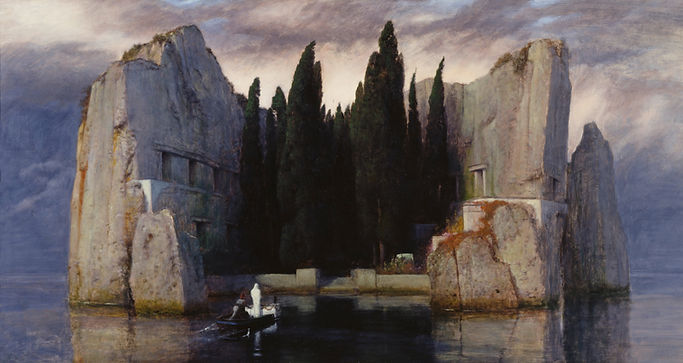
A pivotal figure in 19th-century Symbolism, Swiss painter Arnold Böcklin instinctively moved from naturalistic landscapes into the realm of the visionary and fantastic.
His works are populated by mythological figures set within moody, dreamlike landscapes that explore the union of life and death. His most famous painting, Isle of the Dead, is not a real place but a visualized mood, designed to let the viewer "dreamingly dive into the dark world of shadows." His work deeply influenced later surrealists like Giorgio de Chirico and Max Ernst.
HILMA AF KLINT
(1862 - 1944)
Decades before Kandinsky or Mondrian, Swedish artist and mystic Hilma af Klint was creating radically abstract paintings. Deeply involved in spiritualism and Theosophy, she was part of "The Five," a group who conducted séances to contact spiritual guides called "High Masters."
In 1906, a spirit commissioned her to create The Paintings for the Temple. Working as a conduit, she developed a rich symbolic language of colors and shapes to map the invisible spiritual dimensions of existence. Convinced the world was not ready for her work, she stipulated it remain unseen for 20 years after her death.


AUGUSTIN LESAGE
(1876 - 1954)
A French coal miner with no artistic training, Augustin Lesage's life changed at age 35 when a voice spoke to him from the darkness of the mine, declaring, "One day you will be a painter."
Believing he was guided by spirits, Lesage began creating vast, intricate, and perfectly symmetrical canvases. He claimed to have no overview of the work, surrendering his hands to the "impulse" of his guides. His dense, architectonic patterns are a pure expression of Art Brut—art born from an authentic, unmediated creative impulse.